After the start of the criminal and senseless war unleashed by Putin’s Russia against Ukraine in February 2022, it seemed to many that, due to Russia’s obvious military and economic superiority, the war would not last long. However, after almost two years of dramatic events, hundreds of thousands of deaths, and enormous material damage inflicted on Ukraine, a military equilibrium has set in, accompanied by fatigue and apathy, both in Ukraine and abroad.
What is modern warfare, and what determines its outcome? What role does foreign aid play in this? Where and why is the balance of power shifting, and what developments can be expected from the war in Ukraine?
The War Equation
Modern war is a process of mutual destruction of two (or more) warring parties, each of which consists of three components: the army (the instrument of destruction), the economy (the life support mechanism), and the governing structure (the bearer of political will).
Common sense and historical experience suggest that as a result of technological progress, manpower has ceased to play a decisive role in military confrontation, giving way to the remote destruction of military resources using modern weapons. As a result, military operations come down to the remote destruction of military resources, and its outcome depends on which side runs out of this resource first.
The equation of war for each side can be represented as:
W = R + (P — L) * T
W — Military resource at time t (output variable)
R — The volume of active military resources at the time of the start of the company
P — Volume of military production per unit of time
L — Volume of material losses per unit of time
T — Time from the start of the company
In this equation, the variables R and P represent the total military power of one of the parties and L — depends on the military capabilities of the other. All three variables depend on the economic potential of the participants and the political will to use it. Thus, the key variables in our study will be the size of the economy and military expenditures.
As an illustration, we will use the proposed equation to predict the dynamics of changing the quantity of tanks in the Russian army over the next few years. In this case, the above equation would look like this:
Wt = Rt + (Pt — Lt) * T
Wt — number of operational tanks at time T
Rt — the total number of tanks at the start of the company (6 thousand
active plus 6 thousand suitable for restoration from reserve)
Pt — production of tanks per month (20 new + 90 restored from reserve)[1]
Lt — average tank losses per month (120–150)
T — number of months from the beginning of the company
The following graph shows the evolution over time of the number of operational tanks in the Russian Army, obtained using the above equation for the specified input data. The lines correspond to estimates of average monthly losses of Russian tanks: top — 120 tanks per month [2] and lower — 150 tanks per month [1][3][4].
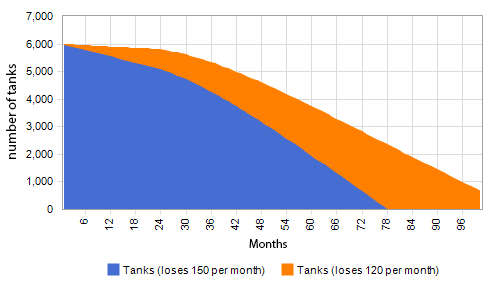
The calculation assumes an increase in the production of new tanks by 10% per year and a decrease in the rate of restoration of tanks from the reserve by 5% per month after the volume of reserves is reduced below 70% of the initial stock.
The above schedule is valid only if the intensity of hostilities remains at the current level. In this case, assuming that hostilities will stop after the number of tanks has been reduced to a certain critical level (let’s say 30% of the initial level), the graph shows that Russia will have enough tank resources for about another 3–4 years of war.
Economics of War
Generally, military spending is unproductive, and although in small amounts (up to 3% of GDP) it can have a stimulating effect on the economy, on an ongoing basis, even a healthy economy can withstand military spending in an amount of no more than 10-12% of GDP. The average annual military expenditure worldwide is 2.2% of global GDP, and the maximum known figure is 12% (Oman, 2022) [5]. In times of war, short-term spikes in military spending are possible, but even during World War II, military spending by the Soviet Union was in the range of 10 — 20% of GDP [6].
Russia
For a resource-rich and technologically backward Russian economy (with GDP less than 5% of the total gross product of the Western coalition), the share of military expenditures most likely cannot exceed 10% of annual GDP. Russia’s military budget before the start of the war was $65 billion per year (3.5% of GDP), in 2022 it was increased by 31% to $86 billion [7]. (4.7% of GDP), and planned for 2024 amounted to $115 billion (about 6% of GDP) [8].
It is important to note that the Russian economy is highly dependent on world energy prices, which deprives it of stability and makes it vulnerable. The following graph shows the values of Russia’s GDP depending on the average annual cost of Brent oil for the period from 2007 to 2018. The graph also shows a point for 2022, which fully corresponds to the approximation.

In 2022, with Brent oil prices around $90 per barrel, Russia’s GDP was $1.78 trillion, and annual revenue from commodity exports was about $400 billion, in 2023, annual revenue from commodity exports, as a result of the combined effect of lower prices for oil, reductions in hydrocarbon exports and sanctions, decreased by a quarter, to $300 billion [9]. Considering that hydrocarbons make up about 70% of the total volume of raw material exports, we can estimate the size of income from raw material exports in 2022 — about $570 billion and in 2023 — about $430 billion.
The graph shows that at the current oil price of $70 — $80 per barrel of Brent, the Russian GDP would be $1.5–1.6 trillion per year, which allows for a military budget of up to $160 billion per year. Western analysts estimate that the cost of the Ukrainian war on each side could be $120-$150 billion per year, which means that maintaining the status quo will allow Russia to continue to wage this war in Ukraine at the current level or even with a slight escalation.
Reducing the price of oil to the natural level of $30 — $35 per barrel will reduce Russia’s GDP to one trillion dollars, limiting Russian military spending to $100 billion a year, which is not enough to continue the war.
Is a scenario with oil prices halving possible? Yes, it is possible and even inevitable — it is a matter of time. Firstly, the age of hydrocarbons has come to an end, and we are already observing a natural slow decline in oil prices as a result of a decrease in the growth rate, and in the future, a reduction in the absolute value of its consumption.
Secondly, thanks to the development of shale oil production technologies, there is no shortage of oil on the market and is not expected, and high oil prices are maintained solely due to the monopolization of the market by OPEC countries. This problem can be resolved through agreements with Saudi Arabia, where the cost of oil production does not exceed $8 per barrel, and/or by lifting administrative restrictions on shale oil production in the United States.
And finally, the most effective method of reducing oil prices should be the long overdue rehabilitation of nuclear energy. Its reputation was completely undeservedly destroyed by two accidents (Chernobyl and Fukushima), where, even taking into account all the consequences, the specific damage caused (per unit of energy produced) turned out to be less than from other types of energy.
With the advent of a new generation of nuclear reactors Small Modular Reactors (SMR) [10] [11], nuclear energy has by far become the cleanest, most reliable and cheapest source of energy. The idea of reviving nuclear power is gaining growing support in both the legislative and executive parts of the US government.
In January of this year, the first SMR power plant received a construction certificate [12]. The attention of investors and big business is also growing. Thus, Elon Musk became one of the most prominent supporters and propagandists of nuclear energy [13], and knowing his track record and capabilities, gives hope.
Ukraine
Ukraine’s GDP at the beginning of the war was about $200 billion a year [14], and the military budget was $6 billion a year [15], which is an order of magnitude less than Russia’s. However, unlike Russia, which single-handedly bears the entire financial burden of the war (including paying for support from allies like China, Belarus, Iran, and North Korea), Ukraine receives significant foreign aid from the Western coalition, which includes more than 41 countries with a total GDP of about $50 trillion
According to the KIEL Institute [16] the total foreign assistance to Ukraine as of October 31, 2023, amounted to about $241 billion, of which about $98 billion was military assistance. Ukraine’s military budget in 2022 was increased from $6 to $44 billion per year [17] or from $0.5 to $3.6 billion per month. Such an unprecedented (more than 7 times) increase in military spending became possible only thanks to external financial support (which can be considered as indirect military assistance).
The monthly volume of foreign aid to Ukraine amounted to $11.5 billion per month, of which $4.7 billion is the military component. However, as a result of delays in deliveries (or some other reasons), the volume of delivered military assistance by the end of October 2023 amounted to only about 20% of the declared (committed) volume or about $1 billion per month [16].
In terms of assistance to Ukraine, against the backdrop of the war in Gaza, the upcoming elections in America, and the accumulated “fatigue” from the war in Ukraine, it is difficult to assess the dynamics of possible changes in the political landscape. However, the average monthly volume of aid (committed) in 2022 and 2023 remained virtually unchanged ($11.3 and $11.8 billion)[16].
Taking into consideration the natural diversity of political forces in democratic systems and, accordingly, the inertia in making and implementing decisions, there is reason to believe that despite the annoying delays, the proposed assistance packages for Ukraine totaling more than $100 billion will be accepted and the total volume of assistance will continue to grow.
However, even if the current level of assistance is maintained, the planned programs provide for the supply of increasingly modern types of weapons, which will lead to a further increase in the effectiveness of the Ukrainian army.
In addition to the deliveries of F-16 aircraft and long-range missiles planned for early 2024ATACMS [18], at the beginning of February 2023, the government of the United States announced its decision to supply GLSDB to Ukraine (ground-launched small-diameter bomb) [19][20] — guided cruise missiles for HIMARS capable of destroying military targets at a distance of up to 150 km, with an accuracy of 1 meter and more than 90% efficiency. With an allocated amount of 2.17 billion dollars and an official unit cost of $40 thousand, the number of shells will be in a few tens of thousands, which approximately corresponds to the total number of military targets in the Russian army on the territory of Ukraine.
A simple calculation shows that the M270 MLRS and M142 HIMARS available in the Ukrainian Army (about 50 units), using GLSDB, can destroy most of the Russian military targets in the occupied territory (about 30 thousand units) in 6–10 days. Most likely, these new weapons will not be used on such a massive scale, but Russian losses will steadily continue to grow.
Conclusion
Currently, the Russian military budget of $10 — $12 billion per month is opposed by the total Ukrainian budget (including foreign aid), of theoretically (committed) $3.6 + $4.7 = $8.3 billion per month, and practically (delivered) — $3.6 + $1 = $4.6 billion. These figures allow us to assess the real relative effectiveness of the Russian army in approximately 30-40%, which is also confirmed by the ratio of material losses: 1: 2.8 = 0.35 or 35% in favor of Ukraine [21].
The capabilities of the Russian armed forces are limited by the funding ceiling of 10% of GDP, which in turn depends on oil prices. At the current level of Brent oil prices of $75 per barrel, Russian military spending cannot exceed $160 billion per year or $13.3 billion per month. With $115 billion per year planned for 2024, the horizon of possible growth comes to only 9%.
Ukraine’s real military budget (including foreign military assistance) currently amounts to $4.6 billion per month, with the prospect of maintaining or increasing both the quantity and quality of incoming weapons. The Ukrainian army turned out to be able to contain the enemy with almost three times the budget, inflicting three times the losses on him with the prospect of critical depletion of his resources within 3–4 years (if we are guided by the calculations for tanks). It is natural to expect that after reducing the budget gap and receiving more modern weapons, the situation at the front will change in favor of Ukraine.
In addition, a likely decline in oil prices could reduce Russian military spending (up to a level of $100 billion per year or $8.3 billion per month), and thereby bring the end of the war closer.
Thus, despite the psychological fatigue from the war and the lack of visible successes at the front, there is no reason to assume that the general course toward the victory of Ukraine (and the Western coalition) over Russia in this war will change.
__________
[1] — Russia Is Losing Tanks X10 Faster Than It Can Make Them (businessinsider.com)
[2] — Oryx: Russian Equipment Losses in Ukraine
[3] — Russian Tank Count from Imaging Analysis | NextBigFuture.com
[4] — How quickly can Russia rebuild its tank fleet? (economist.com)
[5] — List of countries with highest military expenditures — Wikipedia
[6] — Nintil — The Soviet Union: Military Spending
[7] — Рussia military budget 2022 | Statista
[8] — September 2023 — Monthly analysis on Russian fossil fuel exports and sanctions
[9] — Russia to increase military spending by nearly 70%, budget shows (cnn.com)
[10] — What are Small Modular Reactors (SMRs)? | IAEA
[11] — Small modular reactor — Wikipedia
[12] — NRC Certifies First U.S. Small Modular Reactor Design | Department of Energy
[13] — Ilon Mask on Nuclear Power
[14] — Ukraine GDP 1987-2023 | MacroTrends
[15] — Ukraine Military Spending/Defense Budget 1993-2023 | MacroTrends
[16] – KIEL Institute — Ukraine Support Tracker
[17] — Ukraine military budget 2022 | Statista
[18] — TACMS | Lockheed Martin
[19] — S pledges longer-range ‘small-diameter bomb’ for Ukraine (defensenews.com)
[20] — round-Launched Small Diameter Bomb | Saab
[21] — itHub — leedrake5/Russia-Ukraine: Equipment Loss Tracking
 Аргументы не факты